Learning Lebanese Arabic in 2026 takes a different path than learning Modern Standard Arabic from a textbook — the spoken dialect lives in daily conversation, not grammar tables, and the fastest route runs through structured speaking practice from week one.
- Lebanese Arabic beginners progress fastest by speaking from day one, not memorizing grammar tables first.
- A 100-150 word core vocabulary covers most daily conversations within the first 4-6 weeks of study.
- Centrul de Arabă Libaneză pairs beginners with native teacher Ibra for weekly conversation practice — Buy the structured route over app-only study.
- Skip Modern Standard Arabic apps if your goal is conversational Lebanese — the two diverge in vocabulary and pronunciation.
Why this matters
Most people who try to learn Lebanese Arabic on their own hit the same wall: they study Modern Standard Arabic (MSA) content because it's what's widely available, then discover nobody in Beirut actually talks that way. Lebanese Arabic is a spoken Levantine dialect with its own vocabulary, softened consonants, and heavy French and English loanwords — a fact any linguist studying the Levant will confirm.
Starting with the wrong material wastes months. Structured lessons with a native speaker, like the courses at Centrul de Arabă Libaneză, skip the detour and put you in real conversation patterns from the first session — in Bucharest or online, in 2026.
What you'll need
- 20-30 minutes a day for consistent practice — daily beats weekend cramming
- A notebook or flashcard app for tracking new vocabulary
- Audio material — podcasts, songs, or dialogue clips in Lebanese Arabic, not MSA
- Access to a native speaker for pronunciation correction and conversation drills
- A structured course or teacher, such as the Lebanese Arabic classes taught by native teacher Ibra at Centrul de Arabă Libaneză, to keep progress linear instead of scattershot
The steps
1. Learn the sound system before anything else
Lebanese Arabic drops or softens several sounds that trip up English speakers, including the pharyngeal "ع" and the throaty "ح." Spend your first week just listening and repeating these sounds out loud, even before you know what the words mean. Skipping this step is the single biggest reason beginners develop an accent that native speakers struggle to understand later. Expected outcome: by the end of week one, you can distinguish and roughly reproduce the five or six sounds that don't exist in English.
Common mistake: relying on transliterated spelling instead of listening to native audio — transliteration hides sound distinctions that matter.
2. Build a core vocabulary of 100-150 words
Focus on greetings, numbers, food, and daily-life verbs before anything abstract. This core list covers the majority of everyday exchanges — ordering coffee, asking directions, greeting a neighbor — and gives you material to practice sentences with immediately. Most learners hit this milestone in 4-6 weeks of daily study. Expected outcome: you can hold a 2-minute basic conversation about your day.
Common mistake: memorizing word lists in isolation instead of full phrases — Lebanese Arabic relies heavily on set expressions that don't translate word-for-word.
3. Practice speaking from day one
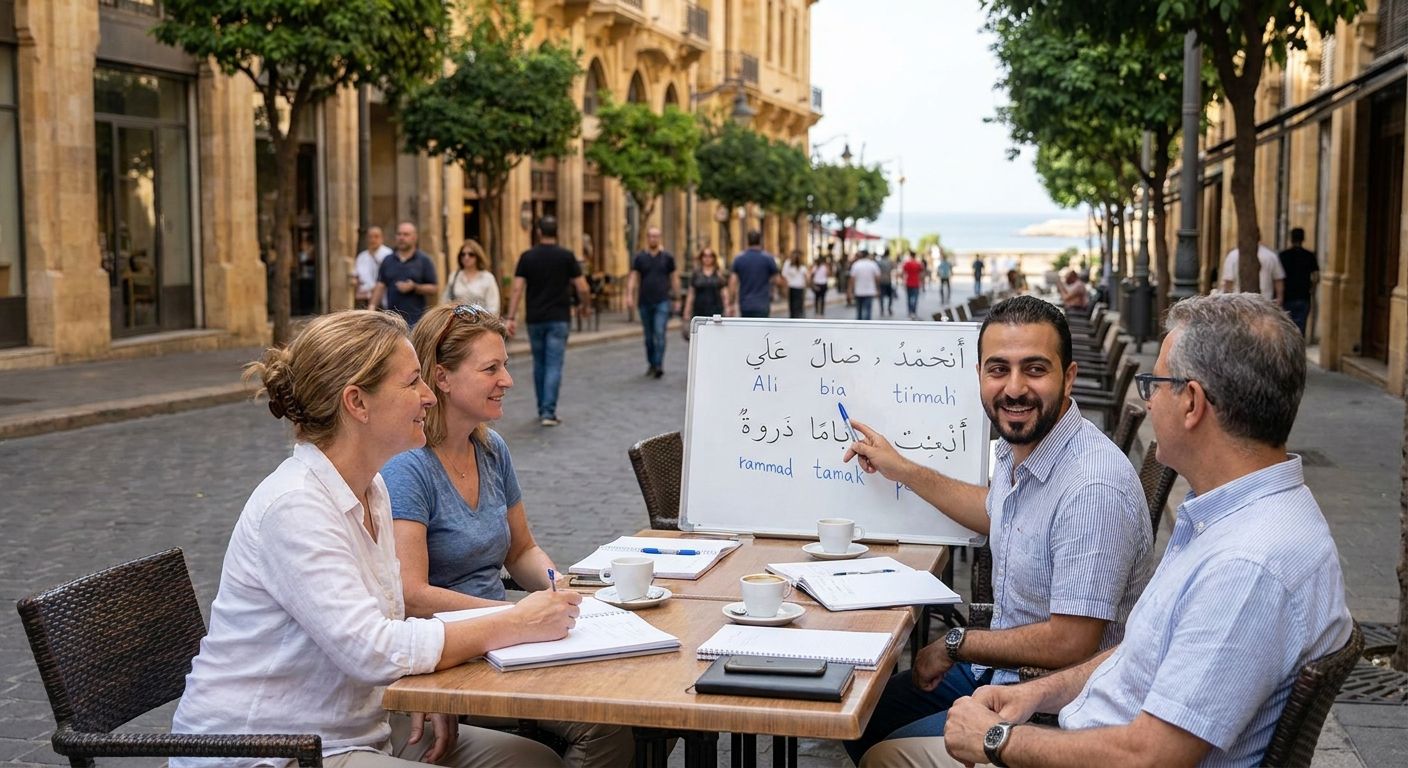
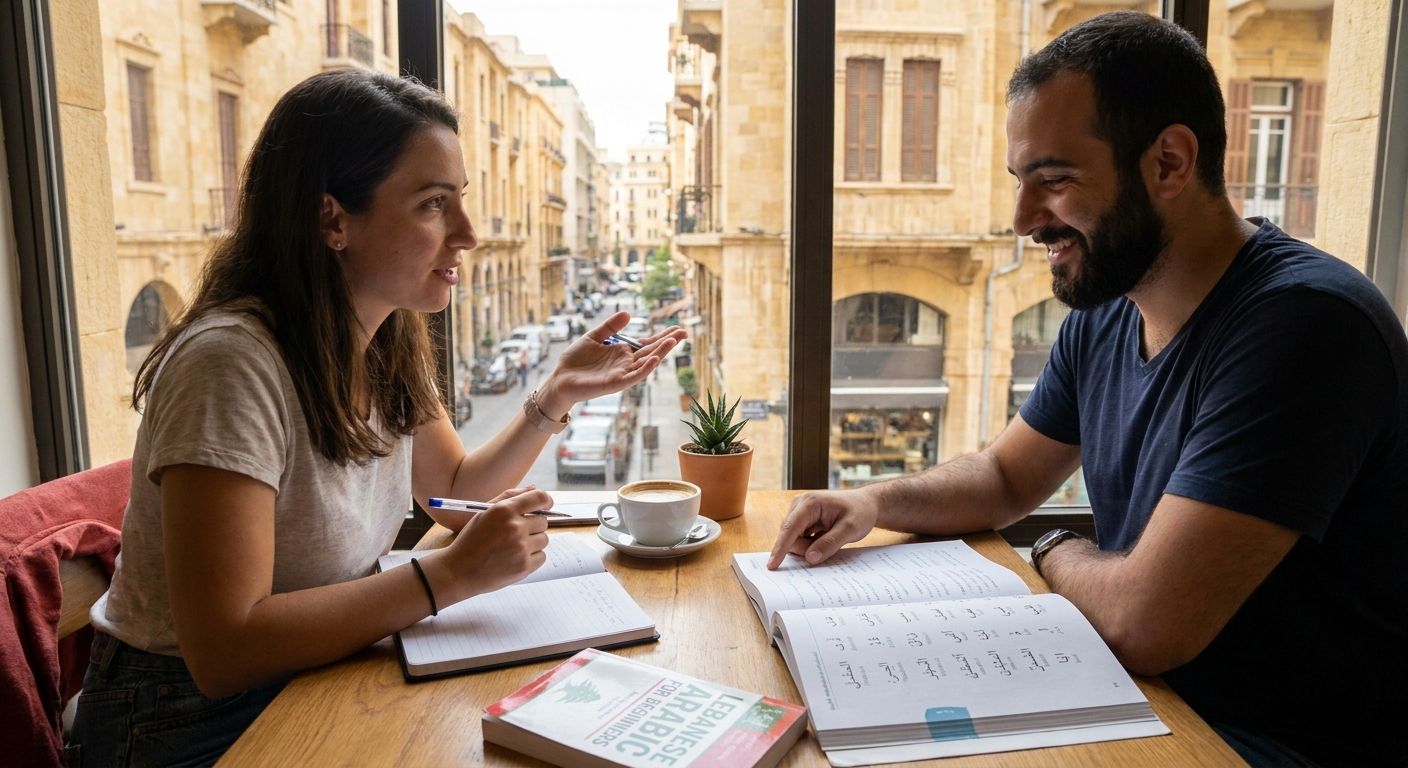
Don't wait until you "know enough" to start talking — that day never comes on its own. Weekly conversation sessions with a native speaker, in person or online, correct pronunciation errors before they calcify into habits. This is where a structured class outperforms solo app study: a native Lebanese teacher hears mistakes an app can't flag. Expected outcome: measurable improvement in fluency confidence within the first month.
Common mistake: practicing only with other non-native learners, which reinforces shared errors.
4. Use spaced repetition for vocabulary retention
Review new words at increasing intervals — one day, three days, one week, two weeks — instead of cramming once and moving on. This single habit, borrowed from decades of memory research, roughly doubles long-term retention compared to passive re-reading. Expected outcome: words you learned a month ago still surface naturally in conversation.
Common mistake: adding 20+ new words a day without reviewing older ones — volume without repetition leaks vocabulary as fast as it's added.
5. Immerse through Lebanese media
Lebanese music, YouTube channels, and TV dialogue expose you to natural speed and slang that structured lessons can't fully replicate. Watch or listen for 15-20 minutes daily, even without understanding everything — your ear adapts to rhythm and intonation before your brain catches every word. Expected outcome: by month three, background listening starts producing recognizable phrases without conscious translation.
Common mistake: choosing MSA news broadcasts for immersion — the formal dialect doesn't match the spoken Lebanese you're trying to learn.
6. Track progress with structured lesson goals
Set monthly checkpoints: hold a 5-minute unscripted conversation by month two, order a full meal in Lebanese Arabic by month three, discuss your job or studies by month six. A course structure, like weekly sessions with teacher Ibra at Centrul de Arabă Libaneză, builds these checkpoints in rather than leaving you to guess your own pace. Expected outcome: visible milestones keep motivation from fading around the 8-week mark, which is when most self-taught learners quit.
Common mistake: studying without any checkpoint, which makes plateaus feel like failure instead of a normal part of the curve.
Start speaking Lebanese Arabic sooner
Weekly lessons with native teacher Ibra, in Bucharest or online.
Troubleshooting
- You keep mixing up Lebanese and Modern Standard Arabic vocabulary. Stick to one primary source of spoken-dialect material until the core vocabulary sticks; mixing dialects early slows recognition speed.
- Your pronunciation still sounds off after weeks of practice. Record yourself and compare against native audio clips — most learners can't hear their own errors without playback.
- You hit a plateau around week 6-8. This is normal; add a new input source (a podcast, a native conversation partner) instead of repeating the same material.
- You freeze up in real conversations despite knowing the words. Practice out loud alone first, then move to low-stakes exchanges with a patient native speaker before attempting fast-paced conversation.
- You can't find enough authentic Lebanese Arabic material online. Structured courses fill this gap directly — a native teacher is a constant, curated source that scattered internet content isn't.
- Motivation drops after the initial excitement fades. Weekly scheduled sessions, rather than "whenever I have time" study, keep the habit from quietly disappearing.
Tools and resources
- Native-speaker audio clips or podcasts in Lebanese Arabic (avoid MSA-only sources)
- A spaced-repetition flashcard app for vocabulary
- A notebook for phrase logging, organized by topic (food, travel, daily life)
- Structured lessons with a native Lebanese teacher — Centrul de Arabă Libaneză runs both in-person classes in Bucharest and online sessions for learners of all levels
- A conversation partner or language exchange for regular speaking reps
“If you can't order coffee in Lebanese Arabic after your first month, you're studying the wrong material.”
What to do next
Once the basics hold — greetings, numbers, simple present-tense conversation — the next jump is sustained dialogue: past tense, expressing opinions, and handling unscripted small talk. That jump is where most self-taught learners stall, because it requires a real conversation partner correcting real-time mistakes. Structured lessons with a native Lebanese teacher close that gap faster than any app, podcast, or workbook alone.
FAQ
What's the best way to learn Lebanese Arabic as a complete beginner in 2026?
The fastest beginner path combines daily vocabulary practice with weekly speaking sessions with a native speaker. Solo app study alone rarely builds real conversation ability within the first few months.
Is Lebanese Arabic the same as Modern Standard Arabic?
No, Lebanese Arabic is a spoken Levantine dialect that differs from Modern Standard Arabic (MSA) in vocabulary, pronunciation, and grammar. MSA is used for formal writing and news broadcasts, while Lebanese Arabic is what's spoken day to day in Lebanon.
How long does it take to learn conversational Lebanese Arabic?
Most learners hold a basic 2-minute conversation after 4-6 weeks of daily study and reach comfortable small talk within 3-6 months with regular speaking practice. Progress speeds up significantly with weekly native-speaker sessions.
Can I learn Lebanese Arabic online instead of in person?
Yes, online lessons with a native teacher work as effectively as in-person classes for conversational fluency. Centrul de Arabă Libaneză offers both formats, taught by native Lebanese teacher Ibra.
How much does it cost to learn Lebanese Arabic with a course in 2026?
Pricing varies by course length and format, so check current course details directly with the provider. Structured courses typically cost more upfront than free apps but shorten the time to real conversational ability.
Do I need to learn the Arabic alphabet to speak Lebanese Arabic?
Not immediately — many beginners start with transliterated or spoken-first methods before tackling the script. Learning the alphabet later helps with reading menus, signs, and text messages once basic speaking is comfortable.
What's the hardest part of learning Lebanese Arabic for English speakers?
The sound system is usually the biggest hurdle, especially pharyngeal and guttural consonants that don't exist in English. Regular listening practice and native-speaker correction fix this faster than self-study alone.
Are Lebanese Arabic and Egyptian or Syrian Arabic mutually understandable?
Levantine dialects like Lebanese and Syrian Arabic are close and largely mutually understandable. Egyptian Arabic differs more in vocabulary and slang but shares enough grammar that speakers can usually follow each other.
One last thing
Lebanese Arabic doesn't have an official standardized written form the way MSA does — most native speakers text each other using "Arabizi," Latin letters mixed with numbers (3 for ع, 7 for ح) to represent sounds the Latin alphabet can't. Learning to read this casual script is often more useful for real-life texting in 2026 than mastering formal Arabic script on day one. Structured lessons that teach spoken Lebanese Arabic first, script second, mirror how the language actually gets used outside a classroom.